
Inroduction: What is HFIP-SEC (GPC)?
Size Exclusion Chromatography (SEC) is a well-established technique used to characterize polymers based on their size in solution, which is closely related to molecular weight.
In simple terms:
- The polymer is dissolved in a solvent and pushed through a column filled with microscopic pores.
- Large polymer chains cannot enter most pores and therefore pass through the column quickly.
- Smaller polymer chains enter more pores and take longer to exit the column.
- The time a polymer chain spends in the column is thus a measure of its size.
By comparing this behavior to reference polymers of known size, we can estimate the molecular weight distribution of the sample.
In this study, hexafluoroisopropanol (HFIP) was used as the solvent. HFIP is particularly suitable for certain resins and polar polymers because it ensures good solubility and stable chromatographic behavior.
Project background
In this case study, we present an anonymized example of a HFIP-SEC analysis (also referred to as GPC, Gel Permeation Chromatography) performed on three resin samples.
The client’s objective was to gain insight into the molecular weight and molecular weight distribution of the materials, key parameters that strongly influence processing behavior and end-use performance of polymeric resins.
All data shown here are confidential and therefore reported in relative and qualitative terms only.
The focus of this case study is to illustrate how the analysis is performed, what type of information it delivers, and how such results can be interpreted.
Analytical objective
Three resin samples (Resin 1, Resin 2, and Resin 3) were submitted for HFIP-SEC analysis with the goal of:
- Determining their molecular weight characteristics
- Comparing their dispersity (breadth of the molecular weight distribution)
For non-chemists: molecular weight in polymers does not refer to one exact number. Instead, polymer samples contain chains of different lengths, and SEC helps describe this distribution in a quantitative way.
Experimental setup
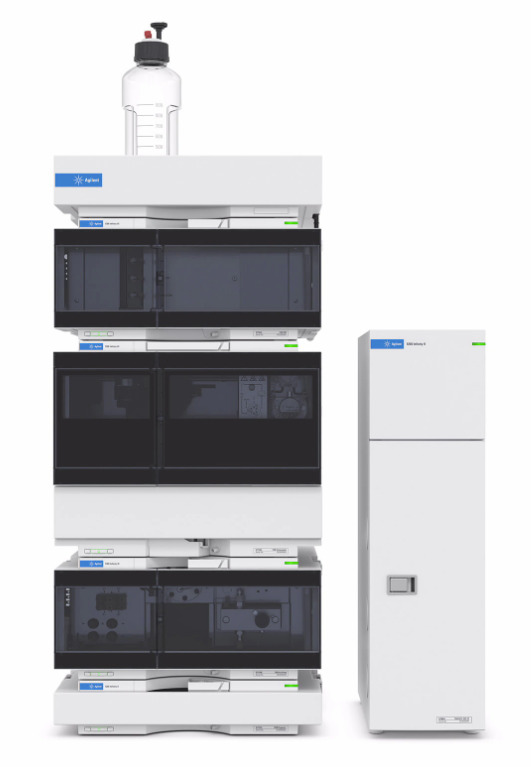
All measurements were performed using a high-performance SEC system consisting of:
- An Agilent 1260 Infinity II autosampler and isocratic pump
- A temperature-controlled SEC column oven (40 °C)
- A column set optimized for polymer separation
- A refractive index detector for polymer signal detection

Acknowledgement: Image is taken from Agilent Website - High-performance GPC/SEC system, 1260 Infinity II GPC/SEC | Agilent with no other purpose than an illustration of the type of instrument used.
The eluent was HFIP containing potassium trifluoroacetate as an additive to ensure stable polymer–solvent interactions. Samples were prepared at approximately 1 mg/mL, filtered to remove dust or undissolved particles, and injected under controlled conditions.
For calibration, poly(methyl methacrylate) (PMMA) standards covering a broad molecular weight range were used.
Understanding the reported parameters
The SEC results are typically expressed using the following parameters:
- Mn (number-average molecular weight)
- Mw (weight-average molecular weight)
- Dispersity (D = Mw/Mn)
- A value close to 1 means a very narrow distribution.
- Higher values indicate a broader range of chain lengths.
Represents the average molecular weight when each polymer chain is counted equally.
Gives more weight to larger polymer chains and is therefore more sensitive to high-molecular-weight fractions.
Indicates how broad the molecular weight distribution is.
Because the measurements were calibrated against PMMA standards, the molecular weights are relative rather than absolute. This is standard practice in SEC and still allows reliable comparison between samples measured under identical conditions.
Results overview
- All three resin samples were fully soluble in HFIP, confirming suitability for SEC analysis.
- Clear and well-defined SEC chromatograms were obtained for each sample.
- Due to confidentiality constraints, absolute molecular weight values are not disclosed.
- The relative Mn, Mw, and dispersity values enabled direct comparison between the three resins.
The chromatograms provided insight into differences in molecular size and distribution, supporting informed decisions on material selection, formulation, or further development.
Conclusion
This case study demonstrates how HFIP-SEC (GPC) analysis is used to characterize resin materials in a robust and reproducible manner. Even when absolute values cannot be disclosed, SEC provides valuable comparative information on molecular weight and dispersity.
Our approach combines:
- Appropriate solvent and column selection
- Careful sample preparation
- Transparent reporting and interpretation
This ensures reliable data that can be directly linked to polymer performance and processing behavior.
If you are working with resins or polymers and need insight into their molecular structure, HFIP-SEC analysis is a powerful and widely accepted analytical tool.
Should you have (analytical) chemical demands, we are pleased to help you!