
Introduction
In many automotive applications, surface durability is a key factor in long-term performance and customer satisfaction. Components exposed to regular cleaning cycles—especially automated car washes—experience repeated mechanical and chemical stresses. These stresses can gradually affect surface appearance, gloss levels, and perceived quality.
To support our customer’s development program, EXPERTA | TESTING performed a series of abrasion resistance evaluations under wet conditions. The objective was to simulate real-world car wash exposure and quantify how the tested components behaved during and after the procedure. Although no pass/fail criteria were specified, the study provides valuable insights into the durability of the applied surface finish.
This case study summarizes the test setup, methodology, and observations collected during the assessment, following ISO15082:2016 (section 11.7) for wet abrasion resistance, combined with gloss assessments according to ISO2813:2014.
Description of Tested Parts
The customer submitted coated parts intended for exterior automotive use. Upon reception, the samples were visually inspected and labeled. Since the evaluation focused on the behavior under simulated car wash conditions, no initial defects or abnormalities were identified that could interfere with the test outcome.
All testing was performed under controlled laboratory conditions at a partner laboratory, following accredited procedures. The samples were conditioned before the test to ensure repeatability and alignment with ISO 17025 requirements.
Scope of the Test
The purpose of the study was twofold:
- Evaluate abrasion resistance under wet conditions according to ISO15082:2016, point 11.7. This standard defines the mechanical loading parameters and wet environment conditions typically experienced in car wash installations.
- Assess gloss retention after exposure using gloss measurements at 20° and 60° according to ISO2813:2014. Gloss is a critical indicator of surface degradation, as changes often correlate with micro-scratching and coating wear.
No acceptance criteria were provided by the customer; therefore, the work focuses on data generation and technical interpretation rather than compliance judgement.
Test Methodology and Equipment
Apparatus
To ensure precise and reproducible measurements, the following equipment was used:
- Thermo-hygrometer – to monitor temperature and humidity throughout the test.
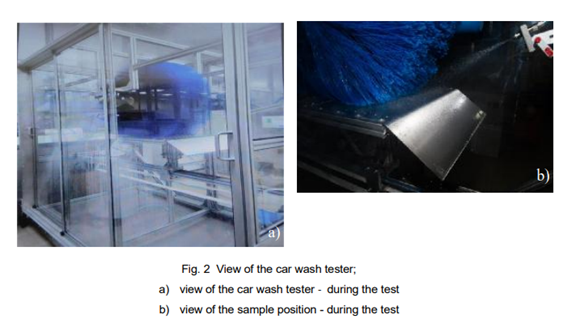
- Car Wash Tester – a mechanical abrasion device capable of simulating repeated brush-type car wash cycles under controlled wetting. (Image to be added by the customer.)

- Gloss meter (20°/60°/85°) – for pre- and post-exposure gloss measurements.
Test Execution
The samples were mounted in the test fixture of the car wash tester.
During the procedure, each sample was exposed to a set number of wet abrasion cycles, reflecting typical mechanical interactions in an automated car wash environment.
The tester applies a combination of:
- Repetitive linear brushing motion
- Continuous controlled wetting
- Defined mechanical load
All parameters were aligned with ISO15082:2016 to ensure the results are representative and comparable to industry benchmarks.
Before and after testing, gloss values were measured at 20° and 60° reflection angles. This dual-angle approach enhances sensitivity for both high-gloss and mid-gloss coatings and helps detect subtle changes in surface uniformity.
Results
The assessment focused on two primary outcomes:
- Visual Condition After Testing
Following the wet abrasion cycles, the tested parts were inspected for:
- Visible micro-scratching
- Changes in surface texture
- Loss of uniformity
- Any structural coating defects
The visual findings indicated that the components withstood the simulated car wash exposure without critical coating failure. No abnormal wear or delamination was observed.
- Gloss Measurements
Gloss retention was evaluated using 20° and 60° geometries as specified by ISO2813:2014. The collected values reflected how surface reflectivity changed due to the mechanical action.
Although exact numerical values cannot be published viewed their sensitivity and study provided was under NDA. We can say the gloss data served as a reliable indicator of coating robustness.
In general, stable gloss values imply that the coating resists micro-abrasion effectively, while notable reductions suggest increased surface wear.
Conclusion
All tests were executed according to the customer’s instructions, general lab requirements according to ISO 17025 accreditation and in accordance with the reference ISO standards mentioned in the report.
Since the customer did not define pass/fail criteria, no compliance conclusion was assigned by EXPERTA | TESTING.
However, the test successfully demonstrated:
- How the coated components behave under accelerated car wash conditions
- The extent of visual and gloss changes after exposure
- That the procedure allows manufacturers to benchmark and optimize coating formulations
The study highlights the importance of realistic abrasion testing for surfaces subjected to routine cleaning operations.
For automotive (exterior) components, maintaining visual quality over time is essential, and controlled laboratory simulations offer valuable insights during material selection and development.
Should you have questions about this test setup, the methodologies used, or how similar analyses could support your own material development, our team will be glad to assist.